 PBXDom
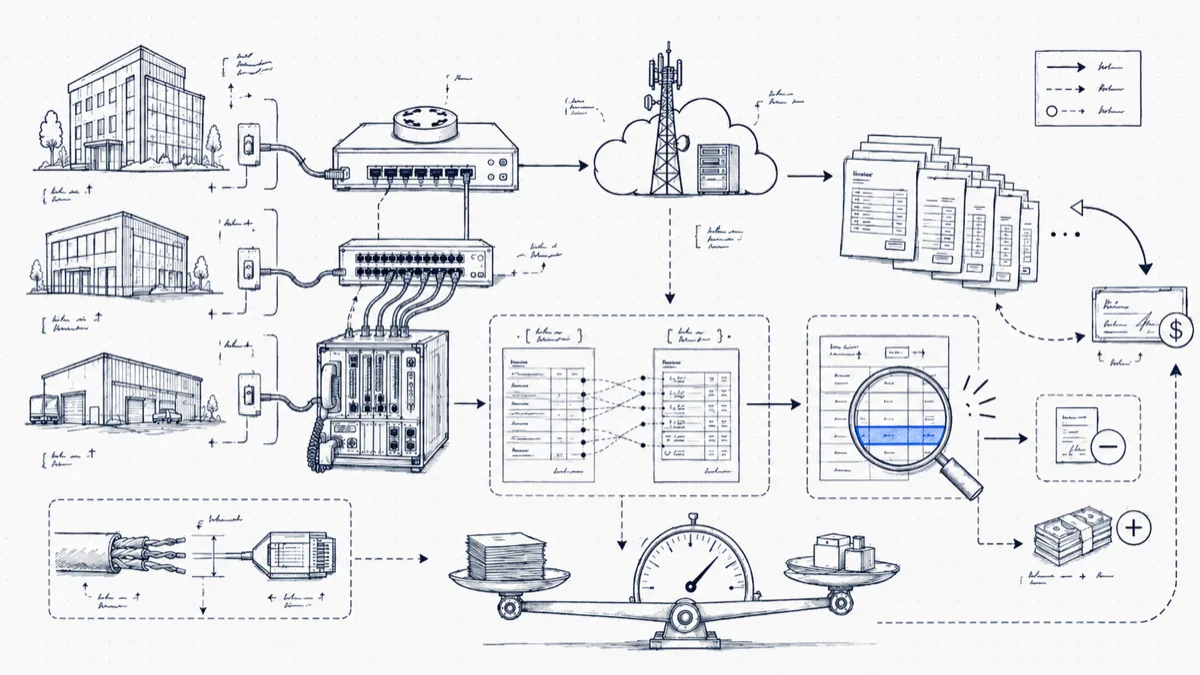
Telecom invoices sit in a blind spot of business finance: too complicated to read line by line, too small to justify a formal audit. The bill arrives, it matches last month within a few dollars, and accounts payable pays it. That loop can run for years.
The loop is expensive, and it runs longest at bigger companies: more accounts, more sites, more invoices with no single owner end to end. Industry analysts have long estimated that between 7% and 12% of telecom charges contain errors, and the errors favor the carrier. An asymmetry explains the tilt: a carrier’s own systems catch under-billing, while over-billing waits for you to catch it. Skip the check and the error becomes the new baseline.
The errors you’ll find
Run enough invoice reviews and the same five categories keep appearing:
Disconnected-but-billed lines. The classic. An analog line for a fax machine that left the building in 2019, an alarm circuit for a door that was bricked over, a DSL backup for a site you closed. Disconnect orders fail, or the request slips through a move’s punch list, and the line keeps billing at $30–50 a month until you notice. This is the most common error and the easiest to prove.
Wrong rate plans. Your contract says $0.029 per long-distance minute; the bill rates calls at $0.049 because the carrier applied a 2017 renewal to one of your accounts and missed the other, or because a moved line landed on the default tariff instead of your negotiated plan. Rate-plan drift hides inside the invoice total: the calls are itemized and the math checks out, against the wrong rate.
Double-billed circuits. Most common after a move, upgrade, or carrier migration: the new circuit starts billing and the old one keeps billing beside it. For a few months both look legitimate; then memory of the migration fades and you pay twice from then on.
Taxes and surcharges on dead services. Even after the carrier credits a base charge, the attached regulatory fees, surcharges, and taxes sometimes keep billing against the dead service. The lines are small, which is why they survive.
Rounding policy mismatches. Contract says 6-second billing increments after the first 30 seconds; the rating system applies full-minute rounding. A 42-second call bills as 42 seconds under the contract and 60 seconds under the wrong rounding, a 43% markup on that call. On a single call the difference is pennies; across 10,000 calls a month it adds up to real money, and no line on the invoice flags it.
The method: reconcile instead of reading
Reading an invoice line by line catches almost nothing, because each line is plausible in isolation. Reconciliation means comparing the invoice against two independent sources of truth that the carrier doesn’t control.
1. Your own CDR, priced by you. Your PBX logs every outbound call: date, duration, number dialed. Price those records yourself against your contracted rates: your rate per minute, your billing increments, your contracted surcharges. Now you have an expected usage charge per category (local, LD, international, toll-free inbound) before the invoice arrives. If the invoice shows $912 of long distance and your own pricing of the same calls says $647, you hold a per-call discrepancy list, which is what wins disputes.
2. A line inventory. List every billing telephone number, circuit ID, and service element on the invoice; carriers provide a CSR (customer service record) on request, and you may need to ask per account, so request one for each BTN you pay under. Then walk the list against reality: which jack, which device, which person? Put anything you cannot put your hand on onto the suspect list. If the company has moved offices in the past five years, expect the walk to find something.
A worked example
A 60-line professional services firm, at $4,800/month across two carrier accounts, ran this reconciliation for the first time. The carrier verified and credited all four findings:
| Finding | How it was caught | Monthly cost |
|---|---|---|
| 4 analog lines with zero calls in 12 months (old fax and alarm lines) | Line inventory vs. CDR (no records, ever) | $154 |
| Old internet circuit still billing 14 months after replacement | Two circuit IDs at one address on the CSR | $96 |
| LD rated at $0.049/min vs. contracted $0.029 on one account, ~5,900 min/mo | Self-priced CDR vs. invoice | $118 |
| Surcharges and taxes still attached to two of the dead lines | Tax lines referencing canceled BTNs | $41 |
Total: $409 a month, about 8.5% of the bill, near the middle of the range analysts have estimated for decades. The findings amount to entropy rather than fraud. The whole exercise took one afternoon plus a week of waiting for the CSR.
Two of the four findings came straight from the CDR archive: lines with zero call records for a year, and per-minute rates that didn’t match the contract. Half the recoverable money sat in data the PBX had produced all along. One person priced the calls against the contract and compared totals; the carrier played no part in surfacing it.
Disputing: how to get the money
Finding the error is half the job. A few rules for the other half:
- Dispute in writing, through the carrier’s formal dispute process, with the evidence attached: your CDR-based pricing for rate disputes, the zero-traffic history for dead lines. Phone-call disputes evaporate.
- Keep paying the undisputed portion. Withholding the whole bill turns a billing dispute into a collections problem.
- Move fast, because credits have a horizon. Carriers tend to limit back-credits to between 90 and 180 days, whatever the contract or tariff says; a two-year-old error pays out six months at best. Each month of delay writes off another month of credit.
- Get the disconnects confirmed in writing with order numbers, then check the next two invoices; dead services have a way of resurrecting.
- Escalate with a spreadsheet. Your account rep can fix in days what the dispute queue does in months, and a rep moves faster on a per-call discrepancy list than on a complaint.
- Track each dispute to resolution. Keep a log: date filed, ticket number, amount, status, credit received. Carriers sometimes “resolve” a dispute by closing the ticket without issuing the credit, and partial credits are common. The log doubles as leverage at renewal: a documented history of billing errors is a strong card when the contract comes up.
Making it monthly instead of heroic
An annual audit finds errors after they have cost you a year. A monthly habit catches them at one month old, inside the credit window, and costs little once the machinery exists, because the work shrinks to variance analysis: this month’s self-priced CDR against this month’s invoice. Flag a category that moved more than a few percent, flag a new line item, and flag a line with billing but no call records for 60 days. Twenty minutes a month covers a bill this size once the first pass is done.
The call accounting side of PBXDom is that machinery: it prices each call in real time against your carrier’s rate plan, so the expected bill exists before the invoice arrives. It rates calls from your existing PBX’s records as they happen, gives you running cost by line, department, and carrier, and flags the line that went quiet or the rate that changed without notice. The first reconciliation tends to pay for the software many times over; check your PBX before choosing guided or self-setup for the 14-day trial.