 PBXDom
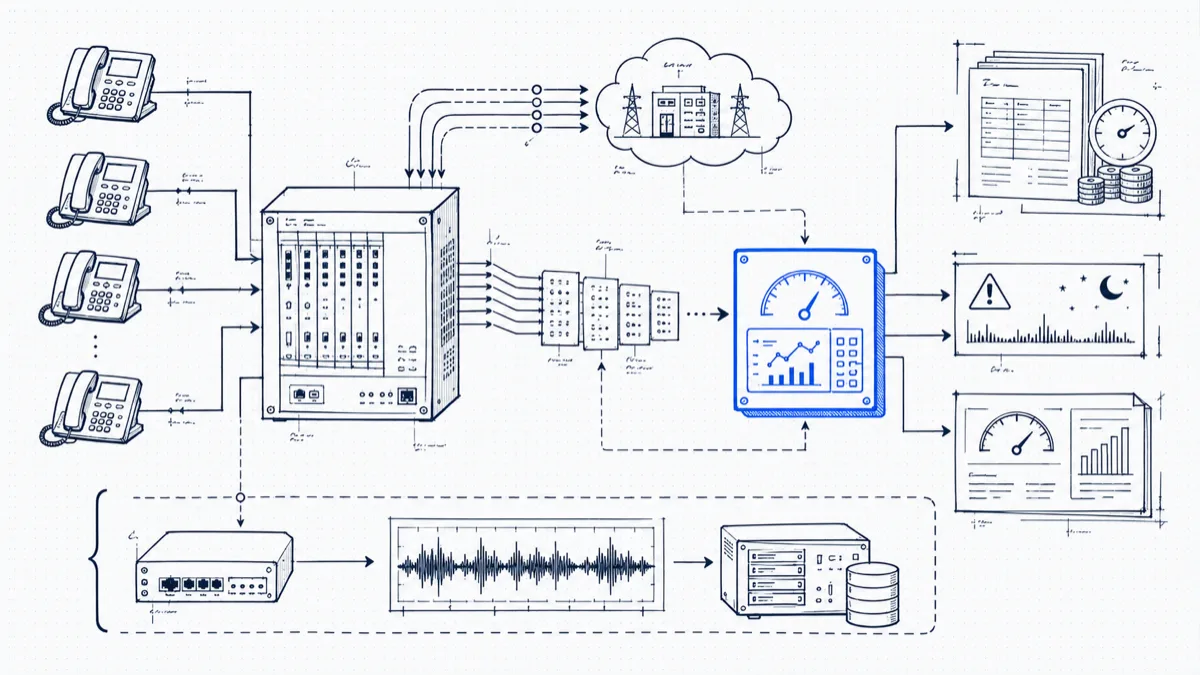
Call accounting is the discipline of pricing and attributing every call that touches your phone system. Your PBX already writes a record for each call: who dialed, what number, when, how long, over which trunk. Call accounting software collects those records, applies your carrier’s rates to them, and turns the result into something a human can act on. Finance gets a department’s phone bill before the carrier sends it. IT gets an alert when an extension starts dialing premium-rate numbers at midnight, and a trunk report that says whether you’re paying for capacity you don’t use.
Draw one boundary before you evaluate anything. Call accounting reads call metadata, the detail records described above. Call recording captures audio; it is a separate product with different costs, different legal obligations, and different consent requirements. If a vendor blurs that line, ask harder questions until you know which one you’re buying.
A short history, because it explains the product
Call accounting is one of the oldest categories of telecom software, and the industry has reinvented the job about every fifteen years.
It started as hotel call billing. In the era when long-distance cost real money, hotels metered guest-room calls and added them to the folio, often with a markup; call accounting was a revenue line. The same machinery let ordinary businesses see, for the first time, which extensions were running up the expensive calls.
Then it became fraud defense. Through the 1990s and 2000s, PBX hacking matured into an industry: compromised voicemail boxes and DISA ports pumping traffic to premium-rate and international numbers, timed for weekends when the office sat empty. Call accounting was often the only system positioned to notice, because it saw each call as it completed.
Per-minute rates have collapsed since then, and the spend moved into trunks, contracts, and risk. The modern job is expense management: knowing what you use, catching invoice errors, attributing cost to the departments that generate it, and spotting fraud that now runs at machine speed.
The five jobs call accounting does in 2026
| # | Job | The question it answers | Who asks |
|---|---|---|---|
| 1 | Cost visibility and forecasting | What will this month’s bill be, before the invoice arrives? | Finance, IT |
| 2 | Chargeback / showback | Which department generated which costs? | Finance, department heads |
| 3 | Fraud and misuse detection | Is anything calling somewhere it shouldn’t? | IT, security |
| 4 | Carrier invoice verification | Does the bill match what we used? | Finance |
| 5 | Capacity planning | How many trunks do we need? | Telecom, IT |
1. Cost visibility and forecasting
Rate each call as it completes and the month-to-date estimate stays current. That kills the worst kind of telecom surprise: the invoice that arrives 40 percent over budget for reasons finance can’t reconstruct three weeks after the fact. It also makes forecasting boring, which is the goal.
2. Department chargeback and showback
Map extensions to departments once, and each call inherits an owner. Some organizations charge the cost back to each department (chargeback); others publish the numbers (showback). Both work, and both change behavior: usage drops once departments see their own line items, with no policy memo required.
3. Fraud and misuse detection
The classic patterns haven’t changed much: international calls from extensions with no history of them, traffic outside business hours, sudden bursts to premium-rate prefixes, odd durations to unfamiliar destinations. Speed has changed: modern toll-fraud operations are automated and can run up thousands of dollars between Friday evening and Monday morning. A fraud check that runs on last month’s invoice is an autopsy; you want detection on the live call stream.
4. Carrier invoice verification
Carriers make billing mistakes, and the mistakes tilt against you: calls rated on the wrong plan, charges for circuits you disconnected, rounding that doesn’t match the contract. With your own rated record of the same traffic, reconciliation becomes a diff instead of an argument. Even a small recovered discrepancy tends to pay for the software that found it.
5. Capacity planning
CDR data gives you the true peak simultaneous usage of each trunk group. Most organizations measuring it for the first time find they’re overprovisioned, paying for circuits sized to a guess made years ago. The same dataset prices a migration: if you’re evaluating SIP trunking or a hosted platform, per-channel quotes mean nothing until you know your real concurrency.
The pipeline, stage by stage
The pipeline has four stages, and stages one and three account for most of the differences between products.
Collection. Each PBX emits call records in its own way. Older systems print SMDR out of a serial port at 9600 baud; newer ones push records over an IP socket or write files on a schedule. A collector (a small app on an always-on machine near the PBX) captures whichever output your system produces and forwards it to the processing engine.
| Method | Typical systems | Notes |
|---|---|---|
| Serial (RS-232) | Older Panasonic, Mitel, Avaya | Records vanish if no collector is listening |
| IP stream / socket | 3CX, Asterisk, newer Mitel and Avaya | Near real-time delivery |
| File transfer | Cisco CallManager, FreePBX | Batched, often every minute or so |
The serial case deserves a warning: many older PBXs buffer little or nothing. If no collector is listening, those records are gone, which is why the collector belongs on a machine that stays on and starts with the operating system.
Normalization. A Cisco CDR record, an Avaya SMDR line, and a Panasonic SMDR line agree on almost nothing: field order, duration units, how transfers appear, what a date looks like. The normalization layer maps them onto one schema, so “calls by department” means the same thing regardless of which switch handled the call. This is unglamorous work, and it’s most of what you’re paying a vendor for.
Rating. The engine matches each normalized call against a rate plan: destination prefix, time of day, connection fee, per-minute price, and billing increment (six-second versus full-minute rounding changes real money at volume). Good systems let you load your contract rates rather than a generic table, because the whole point of stage four is comparing your math to the carrier’s.
Reports and alerts. Dashboards, scheduled reports, and threshold alerts: calls to flagged prefixes, after-hours activity, cost spikes, budget burn rate. The alerts carry the most weight in 2026.
Choosing a system: the questions that matter
Does it support your PBX, down to the exact model, including end-of-life ones? This question disqualifies more vendors than any other. Plenty of organizations run Panasonic or Mitel systems the manufacturer retired years ago; the PBX still switches calls fine, but you need software that still speaks its dialect. Check the supported-systems list against the hardware in your closet rather than the refresh roadmap.
Does it handle serial, IP, and file collection? Mixed estates are normal: a Cisco cluster at headquarters and a twenty-year-old Panasonic at the branch. One product covering all three methods beats running three products.
Real-time or batch? Batch rating is fine for chargeback reports. It is useless against weekend toll fraud. If fraud defense is on your list, you need real-time processing.
Can alerts reach people away from a desk? Email-only alerting is a 2010 answer. Look for SMS, automated voice, Slack, and webhook or Zapier paths, so an alert can reach whoever is on call through a channel they watch at 2 a.m.
Can you load your own rate plans? Generic rate tables make invoice reconciliation impossible. You need your negotiated rates, including the billing increments.
“But we’re moving to the cloud anyway”
Two objections come up in most conversations about call accounting. Both have short answers.
“We’re migrating to hosted voice eventually, so why invest in the old system?” Eventually is doing a lot of work in that sentence. Multi-site migrations run two to four years, and the legacy PBX carries real traffic, and real fraud exposure, the entire time. Call accounting data also scopes the migration itself: real concurrency sizes the SIP channels, per-department traffic decides who moves first, and dead extensions don’t get licenses.
“Calls are free now.” Domestic per-minute rates have fallen to near zero, yes. Toll fraud, premium-rate scams, the trunk circuits themselves, and carrier invoice errors still cost real money. The spend moved, and the visibility has to move with it.
Getting started checklist
- Inventory your PBXs: brand, model, firmware, and how each one emits call records (serial, IP, or file).
- Confirm SMDR/CDR output is enabled; several systems ship with it off.
- Pick an always-on machine for the collector at each site.
- Export your extension list and map extensions to departments while data accumulates.
- Get your carrier contract rates in writing, including billing increments.
- Let two full weeks of traffic accumulate before drawing conclusions.
- Set your first alerts: international calls, premium-rate prefixes, after-hours volume.
- Diff your first rated month against the carrier invoice and chase anything over a few percent.
Where PBXDom fits
PBXDom provides call reporting and accounting for documented systems. Collection methods, available fields, rating configuration, and notification channels depend on your deployment and plan. Check your PBX before choosing guided or self-setup for the 14-day trial.