 PBXDom
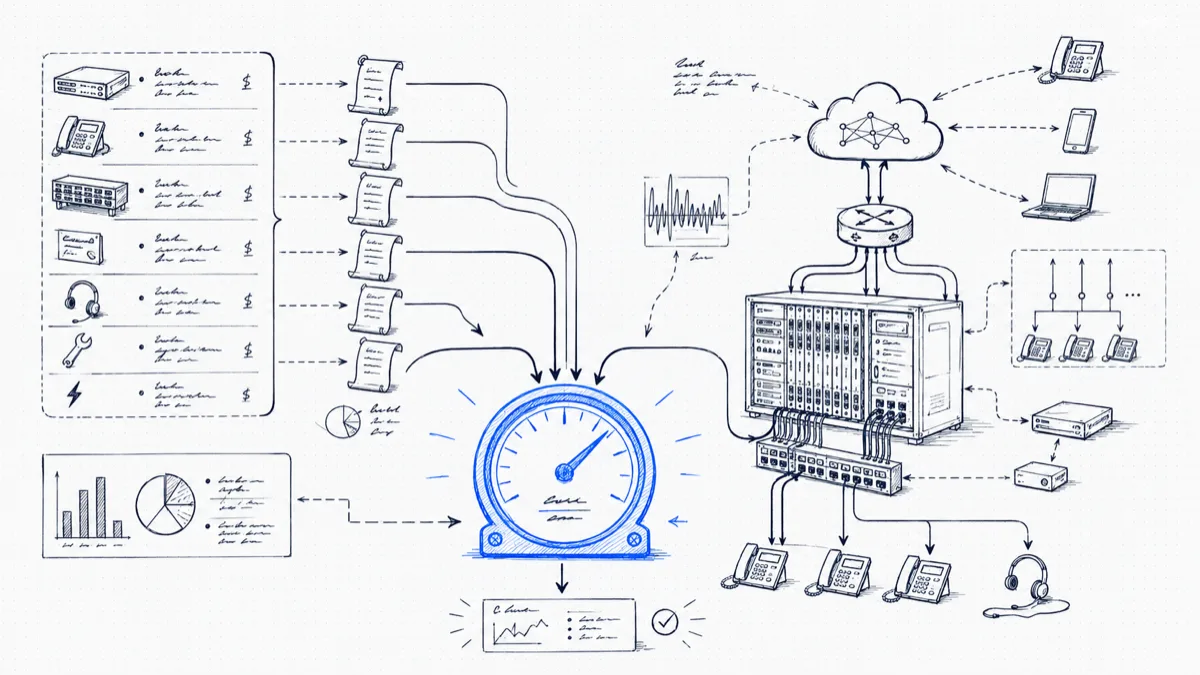
Telecom budget reviews land on the same question each year: what does this money buy us? Line-item answers (trunk fees, maintenance, carrier invoices) make eyes glaze over. One number cuts through: cost per call. Total telecom spend divided by total calls. If you can say “a call costs us 31 cents, down from 38 cents last year,” you have a budget conversation. If you can’t, you have an argument.
The metric persuades when you compute it with full costs and real call counts, and it backfires when you flatter yourself. The method below is the one we use.
What cost per call means
The base definition fits on one line:
Cost per call = total telecom cost for the period / total calls completed in the period
Both halves need discipline. “Total telecom cost” covers the full spend behind making and receiving calls; the carrier bill is one row of it. “Total calls” means calls that connected: count inbound and outbound together, and exclude zero-duration attempts.
Pick a period of one month. Shorter periods are too noisy; quarters hide trends.
What belongs in the numerator
Cherry-pick costs and the number flatters you without persuading the finance team. Include:
- Carrier usage charges: per-minute tolls, long distance, international.
- Trunk and circuit fixed fees: PRI rental, SIP trunk channel fees, DID number charges.
- Maintenance contracts: the annual support agreement on the PBX, divided by twelve.
- The analytics and accounting tooling itself: include whatever you pay for call reporting. A finance person spots that omission in the first pass.
- A reasonable slice of admin labor if telecom is a defined part of someone’s job. A rough estimate (four hours a week at a loaded rate) beats pretending administration is free.
Leave out one-time capital projects; a phone refresh distorts a single month’s metric. Track those costs on their own and amortize them if you want a loaded annual figure.
Three variants worth tracking
The headline number hides useful detail, so keep three versions side by side:
- Cost per call: the headline. Total cost over total connected calls.
- Cost per answered inbound call: total cost over inbound calls a human answered. Service teams should watch this one, because an abandoned call consumed trunk capacity and produced nothing.
- Cost per minute: total cost over total talk minutes. This version earns its keep when call lengths shift; a quarter where average duration jumps from 3 to 5 minutes can make cost per call look flat while cost per minute drops.
None of these requires new data. Your PBX emits the call records as part of normal operation, and the costs sit on invoices you receive anyway.
Benchmark against your own history
You will find articles claiming the “industry average” cost per call runs anywhere from $1 to $10. Ignore them. Those figures come from contact-center studies that include agent salaries, which measure a different thing, or from vendor marketing with no methodology attached. Your trunk mix, geography, and call profile are yours alone.
The benchmark that matters is your own number, month over month. A stable or declining trend says the budget is under control. A jump says something changed (a rate-plan lapse, a misuse problem, a trunk you pay for without using) and gives you a reason to look before the annual invoice shock.
Spotting waste through the metric
Fixed costs sit in the numerator, so idle capacity raises cost per call even while each invoice stays flat. Rent eight PRI channels and use four, and your cost per call carries the dead ones. If call volume dropped 20% after a team moved to a collaboration tool and the trunks stayed unchanged, the metric climbs and tells you to renegotiate.
The same arithmetic surfaces the opposite problem. If cost per call falls because volume surged, check your peak-hour trunk utilization before celebrating; you may be one busy season away from blocked calls.
A worked example: 150 extensions
A 150-extension organization with two PRIs and a SIP trunk group:
| Monthly cost item | Amount |
|---|---|
| 2 × PRI rental | $900 |
| SIP trunks (20 channels) | $300 |
| Carrier usage (LD + international) | $850 |
| PBX maintenance contract (annual $5,400 / 12) | $450 |
| Call analytics tooling | $100 |
| Admin labor (16 hrs @ $55 loaded) | $880 |
| Total | $3,480 |
The PBX logged 11,200 connected calls that month, 41,300 talk minutes, and 5,900 answered inbound calls.
- Cost per call: $3,480 / 11,200 = $0.31
- Cost per answered inbound call: $3,480 / 5,900 = $0.59
- Cost per minute: $3,480 / 41,300 = $0.084
Run the same arithmetic next month. If cost per call drifts to $0.36 on similar volume, the cause sits in one of the six rows above, and the table narrows your search to a few minutes of work.
Budget season: one number a CFO understands
A chart of cost per call over twelve months does more work in a budget meeting than a spreadsheet of line items. It shows stewardship: you measured, you watched the trend, you cut the idle PRI in June and the line bends to prove it. Asking to keep or grow a budget gets far easier when you can show the unit cost of the service falling.
The number also keeps proposed cuts in proportion. If someone proposes dropping the maintenance contract to save $5,400 a year, you can show it’s 13% of telecom spend protecting the asset that carries 11,200 calls a month, about four cents per call for insurance on all of them.
Where PBXDom fits
The tedious part is the denominator and the usage costs: counting each call and pricing it against your carrier’s rate plan. PBXDom does that around the clock. It collects call records from the Cisco, Avaya, Mitel, Panasonic, 3CX, or Asterisk system you already run, prices each call in real time through its call accounting engine, and gives you per-department cost breakdowns plus an estimated bill before the carrier invoice lands. Cost per call turns into a dashboard number you check in a minute instead of a spreadsheet project you rebuild four times a year. Check your PBX before choosing a setup path for the 14-day trial.