 PBXDom
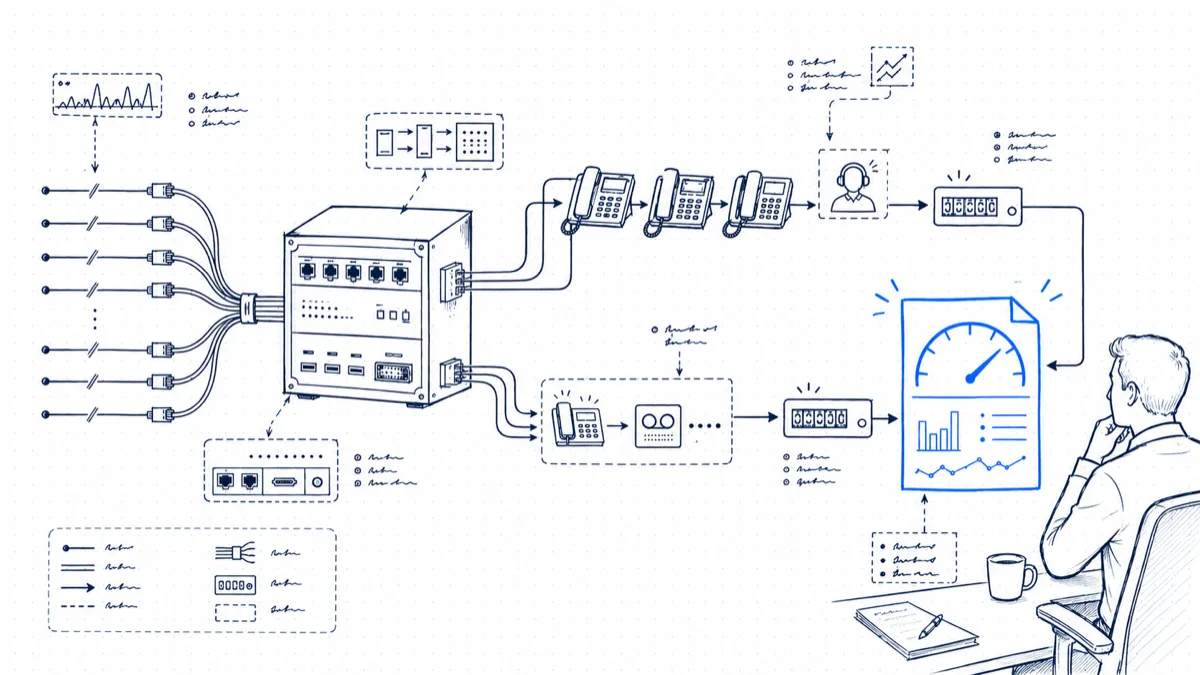
Ask a business owner what yesterday’s revenue was and you’ll get a number. Ask how many phone calls the business missed yesterday and you’ll get a guess, a shrug, or “we don’t miss calls.” Then someone pulls the call records and the room goes quiet, because at a typical small or mid-size office the real number sits between 5 and 20 percent of inbound calls. Call centers track this figure by the half hour. Offices outside the call center seldom track it at all.
The cure is a single daily number, yesterday’s answer rate, delivered each morning to one accountable person. The number works when the definition is airtight. Leave loopholes in the definition and managers will argue with the number, then ignore it.
Defining answer rate so it stands up
The naive version (answered calls divided by total calls) produces a number that is both wrong and easy to wave away. Four corrections make it solid:
Count external inbound only. Internal extension-to-extension calls inflate the denominator and aren’t customers. Outbound doesn’t belong here either.
Count business hours only. A 2 a.m. call against a closed office says nothing about staffing. Define your hours (including lunch, if you close for it) and measure inside them. Track after-hours volume on its own line; a large after-hours count is its own finding, and the fix there is an answering service or better voicemail routing.
Dedupe retries. A caller who rings, gets no answer, calls back four minutes later, and gets through counts as one served caller. Group attempts from the same number within 30–60 minutes and score the caller rather than each attempt. Deduping also tends to raise the rate, which buys credibility for the days the number looks bad.
Decide what voicemail is. For a sales line, count a call that lands in voicemail as missed, and write that into the definition. If your callers leave messages on purpose and those messages get returned, give voicemail its own column. Keep it out of “answered.”
With those rules, a healthy office runs 90% or better during business hours. Mid-80s means callers are noticing. Below 80%, you’re funding your competitors’ sales pipeline.
The one-page format
The report has to survive a 40-second read on a phone, before coffee:
- The number, huge, at the top: “Yesterday: 91% answered, 8 missed of 87.” Put a 10-day mini-trend beside it, so one bad Tuesday reads as a blip.
- The missed list: caller number, time, what it rang (reception, sales group, a direct line). Eight rows fit; if the list runs to eighty, the length itself is the finding.
- An hour-of-day strip: missed calls bucketed by hour, so the pattern shows without analysis.
The report ends there. A phone screen holds all of it, with no chart that needs a desktop, no PDF attachment, and no second page.
Week one
This report changes behavior fast, because the failures it exposes are cheap to fix and a little embarrassing:
- The lunch gap shows up on day one. Half of a typical office’s missed calls cluster between 12:00 and 1:30, when coverage drops to zero without anyone having decided it should. Stagger two lunch breaks and the daily missed count drops by a third before Friday.
- The 8:55 problem. Phones open at 8:30 on paper; humans are settled at 9:05. Either change the published hours or change the habit; the report makes the gap undeniable.
- Friday afternoon. Answer rate at most offices sags 5–10 points after 3 p.m. Friday. Managers doubt the figure until they see their own number, then fix it within a week.
- Coverage assumptions die. “Calls roll to Jenny when reception is busy,” except an office move eight months ago wiped Jenny’s forward. The missed list names the device that rang into silence.
None of these fixes cost money. Measurement pays off here because most missed calls trace back to unexamined routine rather than headcount.
From report to callback workflow
The missed list earns its keep as a task list. The rule that works: someone calls each missed external number back before 10 a.m., skipping the ones the dedupe shows called back and got through. One owner, often the person running the front desk or the sales queue, marks the list done.
Two refinements once the habit sticks: flag missed calls from numbers that have called 2+ times in a week (persistent, warm, and losing patience), and watch the repeat-miss rate. The same number missed twice is the stat that should sting.
Put a dollar figure on the loop, even a rough one. If a sales line misses eight calls a day, the dedupe shows five distinct callers who gave up for good, and one caller in ten has been turning into a $600 customer, the lunch gap costs about $300 a day, or $6,000 a month. The arithmetic is crude on purpose: its job is to put “fix the phones” on the budget next to line items that already have numbers attached.
Where PBXDom fits
Use PBXDom reports and dashboards to review the call records your supported system exports. Confirm the available fields, reporting filters, and retry analysis during evaluation. Setup time depends on PBX output, the collector host, and access. Check your PBX to choose a setup path.